French Tian Bowls: Their History, Colours and Place in the Home
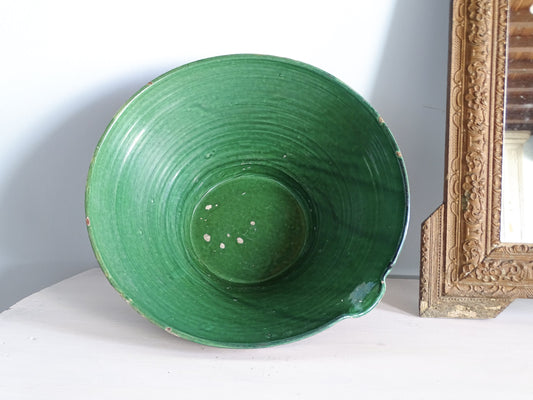
Set several antique French tian bowls together and the differences are immediately apparent. Deep green beside ochre yellow, steeply sloping sides alongside a shallower, more open form, glossy interiors contrasting with surfaces softened by years of use.
Once familiar objects in the kitchens of southern France, these earthenware bowls are now wonderful pieces to decorate with. Their generous shapes look just as natural on an antique chest as they do on a kitchen table, while their colourful glazes and rustic terracotta bring warmth and texture to a room.
We particularly appreciate the individuality of these old bowls. Some retain beautifully rich glazes, while others have worn surfaces revealing glimpses of the clay beneath. No two are quite alike, and the traces of their former lives are often what make them so special.
What Is a French Tian Bowl?
A tian is a traditional French earthenware basin, particularly associated with Provence and the wider south of France.
Most have a broad, open top with sides tapering towards a smaller, flat base, although they vary considerably in size. Their interiors are usually glazed, while the outside is often left largely unglazed, showing the natural terracotta beneath.

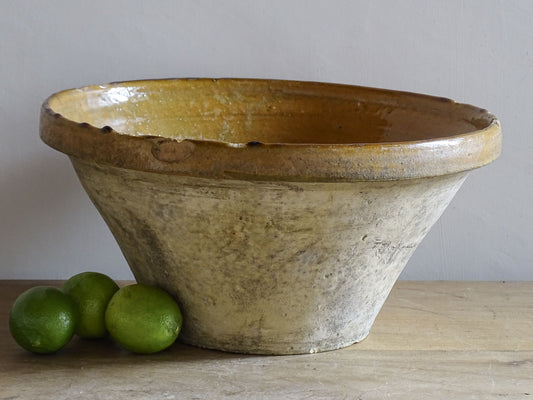
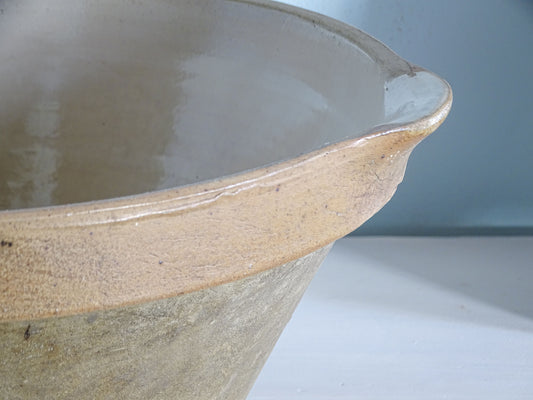
The characteristic flared shape of a traditional French tian bowl, with a small handle and pouring lip.
Although their basic shape is recognisable, there is considerable variation between individual bowls. Some have deep, steeply sloping sides, while others are wider and shallower, with thick rims, pouring lips or small handles.
It is these differences that make them so interesting. Even when several bowls share the same traditional glaze, their proportions and finishes can give each an entirely different appearance.
Tian, Grésale or Jatte? Different Names Across Southern France
While the word tian is particularly associated with Provence, similar forms of traditional earthenware were used across southern France.
Along the Mediterranean coast, including Languedoc and the region around Narbonne, potters produced large glazed basins for everyday household use. Related forms were also made further west, including in the Lauragais around Castelnaudary.
Depending on their region and form, these bowls may be described as a grésale or grasale, or sometimes more generally as a jatte. The names are not always exact equivalents, but they belong to overlapping traditions of practical French pottery.
These regional differences are part of what makes traditional French pottery so interesting. Even within the same area, individual potters and workshops developed their own variations. A slight change in the angle of a bowl, the thickness of its rim or the colour of its glaze can give it a completely different character.
Made for Everyday Life
Long before they became decorative objects, tian bowls were part of the everyday workings of a French household.
Their generous openings made them useful for preparing ingredients, washing vegetables and mixing food, while larger basins could accommodate considerable quantities. Related regional vessels also had uses in food preservation and other domestic tasks.
Many surviving antique examples date from the 19th and early 20th centuries, although the pottery traditions behind them are considerably older.
Their shapes developed from practical needs. A broad opening made the bowl accessible, while a smaller base allowed it to rest securely on a work surface.
Some examples have a pouring lip formed into the rim, a small detail that is particularly interesting when seen close up.

Others have small loop handles or more pronounced handles at the sides. On older examples, these details can be wonderfully irregular, with slight differences in thickness and shape.
These bowls were made to be useful rather than decorative, yet the same generous shapes that served a purpose in the kitchen are what make them so appealing in our homes today. The wide rims, sloping sides and little variations from one piece to another give them a beauty that has outlasted their original purpose.
The Beautiful Colours of Traditional French Pottery
One of the first things that draws us to an antique tian is often its glaze.
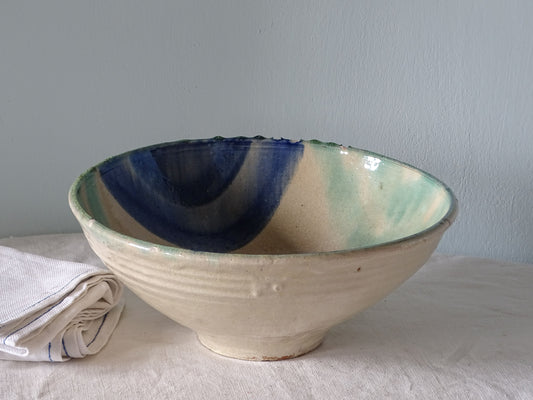
Ochre yellow and green are perhaps the most familiar colours, but within those shades there is remarkable variety.
Yellow can range from a soft honey tone to deep mustard, golden ochre or a rich orange. Green glazes can be pale and slightly muted, olive-toned or wonderfully vibrant.
These colours come from traditional glazing techniques, and the results are rarely identical from one piece to another.

Sometimes the glaze has gathered more thickly towards the bottom, creating a deeper colour. In other places, subtle streaks or variations appear across the surface, following the shape of the bowl.
Looking closely, you can often see the concentric marks left during its making, still visible beneath the glossy glaze.
We particularly love the contrast between the glazed interiors and the rustic exteriors. The bright colours catch the eye, while the exposed clay provides a softer, earthier finish.
It is a combination that works beautifully in French country interiors, especially alongside old wood, natural linen, stone, copper and other pieces of antique French pottery.
Looking a Little Closer: How Tian Bowls Were Made
Many traditional tian bowls were shaped on a potter's wheel, with the clay worked into their familiar wide, tapering forms.
Although the glazed interiors tend to attract the most attention, the undersides can be just as interesting.
Turn an old bowl over and you may find a rough, unglazed base, visible circular marks and subtle irregularities in the clay.

Occasionally, numbers or other markings have been incised into the surface. These might indicate a size, workshop reference or something connected with the production process, although their precise meaning is not always known.
These small details are easy to overlook when a bowl is displayed upright, but they add another layer of interest to an already beautiful piece.
The Beauty of Age and Wear
One of the things we love most about antique French pottery is the way its appearance changes with age.
Tian bowls were made for everyday use, and many surviving examples still carry traces of those years spent in French kitchens.
The glaze may have worn thin around the rim, small areas of terracotta may show through the colour, or the interior may have developed a softer, more muted appearance.
What began as a bright, glossy household bowl can become something quite different after decades of use.

There is something especially attractive about the way time changes these surfaces. The original glaze may remain rich and glossy in places, while elsewhere it has softened or worn away to reveal the warm, earthy tones beneath.
A bowl with patches of yellow glaze remaining against pale, exposed terracotta can be every bit as beautiful as one with a wonderfully preserved interior. Each has its own appeal, and the contrast between different finishes makes these pieces particularly interesting when displayed together.
The wear also gives us a connection to the bowl's past. A softened rim or an interior marked by years of use hints at the kitchens and households where these pieces once belonged. We may never know their individual stories, but they carry something of that history in their surfaces.
When displayed among other antiques, these variations add so much interest. A glossy green tian beside a heavily worn yellow example creates a beautiful contrast, not only in colour but also in texture.
It is often these irregular surfaces and small imperfections that make antique pottery so rewarding to decorate with.
Bringing Tian Bowls Back into the Kitchen
The kitchen is perhaps the most natural place to display an antique tian.
Their generous shapes sit beautifully on old wooden tables, kitchen dressers and sideboards, especially when arranged alongside other pieces that would once have been familiar in a French household.

We particularly like combining them with antique pottery jugs, wooden cutting boards and folded linen. The mixture of glazed earthenware, worn wood and natural fabrics creates a relaxed French country look without needing much additional decoration.
A large ochre tian can make a wonderful centrepiece on a kitchen table, while smaller examples work beautifully on open shelves or as part of a grouping of pottery.
There is no need for everything to match. A yellow tian alongside a green-glazed pitcher or a rustic French confit pot often creates a far more interesting arrangement than a collection of identical pieces.
The different shapes, colours and finishes give the display depth, while still feeling connected through their shared history as everyday household objects.
Decorating with Antique French Tian Bowls Beyond the Kitchen
Although they originated as practical kitchen vessels, tian bowls are far too beautiful to be confined to one room.
Their substantial shapes and rich colours make them wonderful decorative pieces throughout the home.
A large bowl can look stunning on an antique chest, console or sideboard, displayed simply on its own or alongside a few carefully chosen objects.

We particularly like how naturally a tian can sit among other pieces in a room. It does not necessarily need to be the centre of attention.
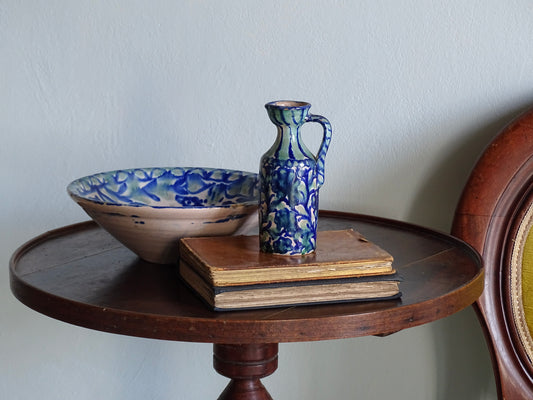
Placed on an old wooden chest, for example, the bowl's simple shape and worn surface complement the texture of the furniture. A few books, a colourful jug or a piece of artwork can complete the arrangement.
The warm yellow and green glazes work particularly well with antique wood, while their earthy terracotta exteriors can bring texture to lighter, more neutral interiors.
Larger examples are especially effective on substantial pieces of furniture, where their broad forms have room to be appreciated. Smaller bowls can be grouped together, perhaps mixing different shades of yellow and green, or displayed among other favourite objects.
We also love the contrast between these rustic bowls and more decorative antiques. A heavily worn tian beneath an ornate gilt mirror, for example, brings together two very different pieces that complement one another beautifully.
It is this versatility that makes traditional French pottery so enjoyable to work with.
A Place for Antique Tian Bowls in Today's Interiors
What we love most about antique French tian bowls is how easily they find a place in a home today.
Despite their origins as ordinary household pottery, they have a strong decorative presence. Their simple, generous forms work in both traditional and contemporary interiors, while their glazes introduce colour in a wonderfully natural way.
For us, the most interesting examples are not necessarily the largest or the most perfectly preserved. Sometimes it is a particular shade of green, an unusually shaped rim or a beautifully worn surface that makes a bowl stand out.
Each has something different to offer, whether displayed alone or among other pieces of collected French pottery.
And perhaps that is what makes them so special. These were once objects used in the most ordinary moments of daily life, yet their shapes, colours and traces of age have made them beautiful additions to our homes generations later.
Explore our Antique & Vintage Ceramic Bowls collection to discover traditional French tian bowls and other individually sourced pieces of antique earthenware at La Maison de Belasyse.
For more on traditional French pottery, explore our guide to French pottery jugs and pitchers.