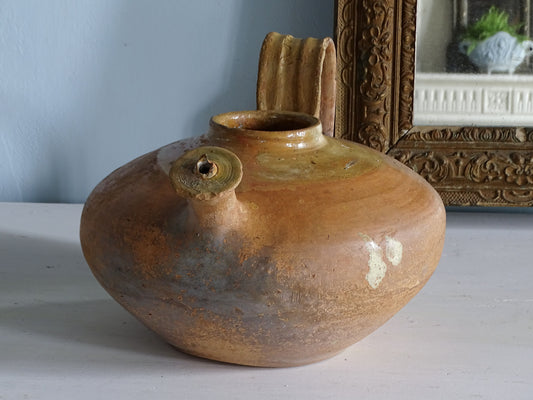
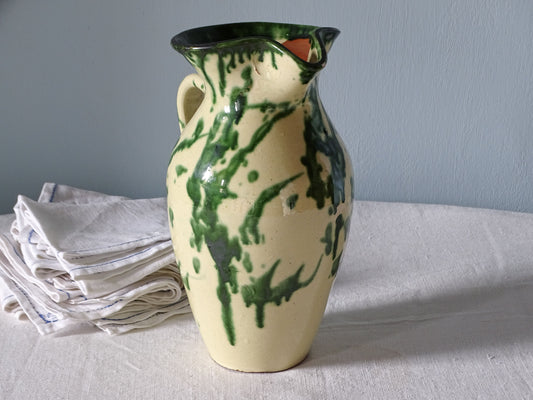
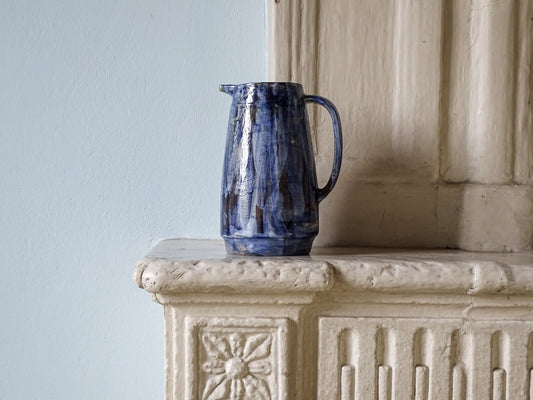
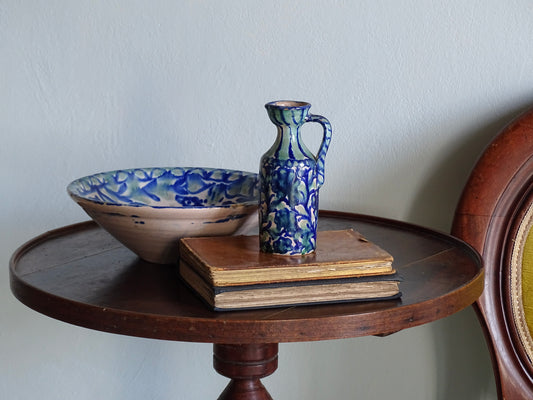
A Guide to Traditional French Pottery Jugs and Pitchers
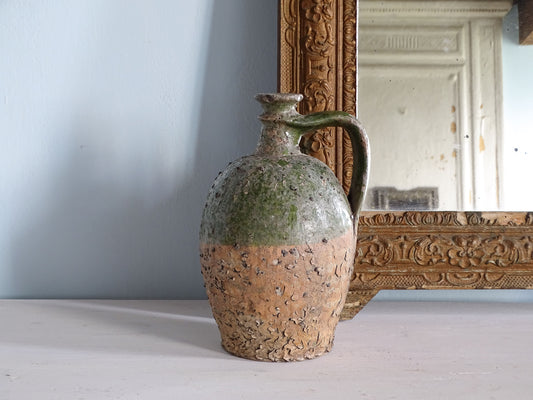
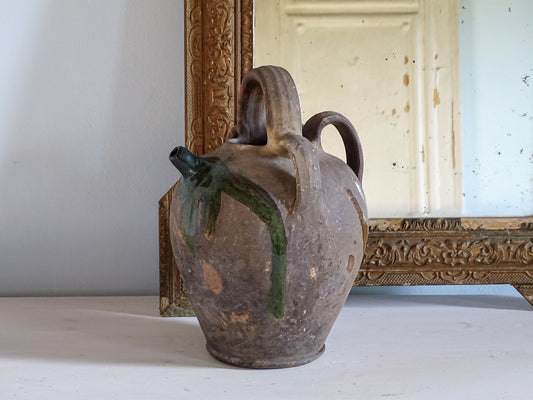
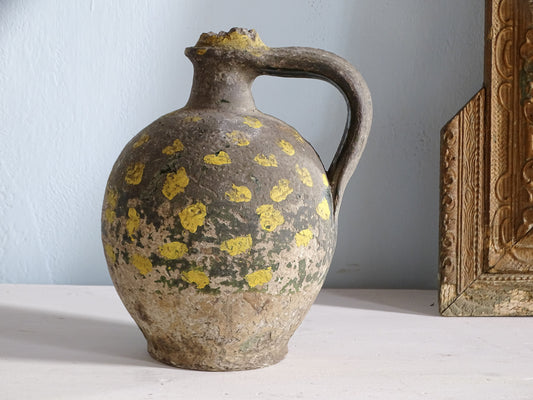
Gather together a collection of antique French pottery jugs and the variety is immediately apparent. Tall, narrow pitchers stand alongside rounded water vessels, some with several handles and small pouring spouts, others with broad openings and simple, familiar shapes. Their glazes range from warm honey yellow and deep brown to soft green, while others have little more than a trace of colour remaining on the natural terracotta.
These differences reflect the many uses pottery once had in French households. Jugs were made for collecting water, storing oil, serving drinks, heating liquids and even preparing fresh cheese. Across France, local potters developed forms suited to the needs of their communities, giving rise to a fascinating variety of regional names and shapes.
Today, these old vessels have a wonderful decorative presence. Their sculptural forms, rich colours and worn surfaces look just as natural on a kitchen dresser as they do on an antique chest or alongside other collected objects.
We particularly appreciate how individual these pieces can be. Even two jugs made for exactly the same purpose may differ considerably in shape, glaze and proportion.
Why Are There So Many Different Types of French Pottery Jugs?
The familiar French words cruche and pichet are often used to describe jugs and pitchers, but traditional French pottery has a much more varied vocabulary.
Depending on the region, a vessel might be called a dourne, gargoulette, orjol or another local name. Some terms refer to a particular form or traditional purpose, while others have been used more broadly, sometimes with different meanings from one area to another.
These regional distinctions developed over generations. Potters worked with locally available clay and adapted their designs to how vessels would be carried, stored and used. A jug intended to transport water from a village fountain required quite different features from one used to pour oil or heat liquids over a fire.
It is worth remembering that these names are not always precise classifications. Related forms sometimes overlap, and an old vessel may be described differently depending on where it originated.
This variety is one of the pleasures of collecting traditional French pottery. The shape of a handle, the position of a spout or the way a glaze has been applied can tell us something about a vessel's original purpose.
Dournes: Traditional Water Jugs of South West France
Among the most distinctive forms of French country pottery is the dourne, a traditional vessel associated with carrying and storing water.
Dournes were particularly familiar in Gascony and parts of South West France, including the Landes, where pottery production was closely connected to the everyday needs of rural households.
In some areas, these substantial water jugs were carried on the head, often supported by a small rolled cloth or cushion. Their rounded bodies provided generous capacity, while the handles and pouring openings made them practical for transporting and dispensing water.

A traditional French dourne, with its rounded body, paired handles and warm ochre and brown glaze.
Although dournes share a common purpose, their forms can vary considerably. Some have broad, rounded bodies with pronounced handles, while others are more upright, with a narrower neck and a simple carrying handle.
The example above has a particularly interesting rounded body, with its rich ochre and brown glaze emphasising the curves of the vessel.

The second example is quite different, with a broad, rounded body, a single arched handle and a short pouring spout. Its pale, natural tones and traces of darker glaze give it an understated appearance.
Seen together, these two jugs illustrate how much variety can exist within traditional French water vessels.
Their distinctive silhouettes also make them wonderful pieces to display. A rounded dourne can look particularly effective on a substantial wooden table or chest, where its unusual form can be appreciated from different angles.
Gargoulettes: Water Jugs with Distinctive Handles and Spouts
The gargoulette is another traditional water vessel, particularly associated with southern France and the wider Mediterranean.
Gargoulettes were used for carrying, storing and drinking water. In some traditional forms, the porous terracotta helped keep water cool through evaporation, something particularly useful in hot climates.
Their appearance varies, but many have a rounded body, an arched carrying handle and a narrow tubular spout. Additional handles may be positioned around the vessel to assist with carrying and pouring.

Two traditional French gargoulettes, showing differences in handle arrangement, form and glaze.
These two antique gargoulettes provide a particularly good example of the differences found within a single traditional form.
The first has a warm, pale terracotta body with ochre glaze around its upper section, while the second has a darker, more muted surface with striking green glaze running down from the shoulder.
The arrangement of the handles also differs, with one example having a particularly elaborate multi-handle construction.
Although both vessels were designed around the practical business of transporting and pouring liquids, their different shapes give them quite distinct appearances.
The arched handles are especially attractive from a decorative point of view. They introduce height and movement to a display, while the narrow spouts and rounded bodies give the vessels a wonderfully sculptural quality.
A gargoulette can work beautifully on its own, but placing two contrasting examples together allows these differences to become much more apparent.
Orjols: Traditional Water Vessels of Southern France
The orjol is a traditional pottery water vessel associated particularly with Languedoc and parts of southern France.
Like other regional water jugs, orjols were used for transporting water from fountains or wells to the home. They often have substantial rounded bodies, relatively narrow openings and handles positioned to make carrying easier.

A collection of traditional southern French pottery, with contrasting yellow, brown and green glazes.
The collection above shows how these traditional vessels can vary in glaze while retaining closely related forms.
Warm yellow, ochre and brown finishes are often found on antique French earthenware, sometimes with touches of green or irregular areas where the glaze has run during firing.
These differences are particularly interesting when several examples are displayed together. The repeated shapes give the group a sense of continuity, while variations in colour and surface prevent it from looking too uniform.

This individual orjol has a wonderfully rounded body with two raised handles and a rich combination of yellow and reddish-brown glaze.
Its generous proportions make it an attractive decorative piece, even without flowers or other additions.
One of the things we particularly like about these larger water vessels is that they often need very little surrounding decoration. Their unusual shapes and substantial presence are enough to make them interesting in their own right.
Walnut Oil Jugs: Pottery Connected to Rural French Life
Not every traditional French pottery jug was intended for water.
In regions where walnuts were widely grown, particularly the Périgord, Limousin and parts of central France, walnut oil was an important part of everyday life.
Used in cooking and historically for lighting, the oil needed to be stored and transported in suitable containers. Potters produced a variety of earthenware vessels for this purpose, often with rounded bodies, relatively narrow openings and substantial handles.
Some forms are particularly distinctive, with an almost spherical body, several handles and a short pouring spout.

A rounded antique walnut oil jug with rich orange glaze and a short pouring spout.
This wonderfully rounded walnut oil jug has a rich orange glaze, with a broad body and short spout.
Its unusual proportions make it an especially sculptural piece. The rounded shape contrasts beautifully with more upright pitchers, and the warmth of the glaze works particularly well alongside old wood and natural materials.

Other walnut oil jugs have a more elongated form, such as this example with its narrow neck, two handles and softly mottled olive-brown glaze.
Although their shapes differ considerably, both vessels belong to the wider tradition of practical pottery made to store and pour liquids.
There is something particularly interesting about these old oil jugs because they connect so closely with the agricultural traditions of rural France.
Today, their rounded forms and earthy colours make them excellent additions to French country interiors. They can be displayed alone on a shelf or dresser, or grouped with other glazed pottery to create a collection of contrasting shapes.
Dieulefit Pottery: Striped Glazes and Traditional Kitchen Vessels
The town of Dieulefit, in the Drôme department of south-eastern France, has a long association with pottery production.
Its traditional terre vernissée, or glazed earthenware, included a wide range of practical household pieces, from cooking pots and dishes to pitchers and other vessels used in the kitchen.
Among the most recognisable decorative finishes associated with this pottery tradition are warm cream or yellow glazes marked with irregular bands, streaks and patches of dark brown.

Traditional Dieulefit pottery pitchers, with irregular brown stripes over cream and yellow glazes.
These striped pottery pieces are particularly attractive when collected together.
Although they share similar glazes, there is considerable variation in height, shape and proportion. Some are tall and cylindrical, while others are shorter and more rounded, with different arrangements of handles, pouring lips and lids.
Their decoration has a wonderfully informal appearance. The brown glaze often forms irregular horizontal bands, with areas where the colour has gathered or run across the lighter surface.

This lidded example shows the contrast particularly clearly, with dark brown markings across a creamy yellow ground.
The practical forms of Dieulefit pottery reflect its history as a centre for everyday kitchen earthenware, including vessels used in cooking and food preparation. The precise purpose of an individual antique piece, however, is not always easy to establish from its shape alone.
From a decorative point of view, these striped jugs are particularly interesting because they introduce pattern without relying on elaborate painted designs.
A group of different sizes arranged on open wooden shelving can be extremely effective, particularly in a kitchen or dining room. The repeated cream and brown glazes create a connection between the pieces, while their different shapes bring variety to the display.
French Stoneware Jugs: Simple Forms and Natural Glazes
Alongside glazed terracotta and earthenware, stoneware has an important place in the history of French household pottery.
Known in French as grès, stoneware is fired at higher temperatures than ordinary earthenware, producing a harder, denser ceramic body.
Its strength and relatively low porosity made it particularly useful for everyday vessels intended to store and transport liquids and other household provisions.

A collection of French stoneware jugs and storage vessels, showing different shapes and natural glaze finishes.
Traditional French stoneware jugs often have simple, practical shapes with narrow necks, rounded shoulders and sturdy handles.
Their glazes can be wonderfully varied, ranging from pale cream and warm honey tones to deeper browns, sometimes with irregular darker patches or runs across the surface.
Many retain visible turning lines from the potter's wheel, while others have slightly uneven surfaces and small variations in shape.
Compared with the brighter glazed earthenware of southern France, stoneware often has a quieter appearance.
This makes it particularly useful when decorating. A group of stoneware pitchers in related neutral shades can introduce texture and subtle colour variation without overwhelming a room.
They look especially good alongside old linen, antique wooden furniture and more colourful pieces of French pottery.
Even relatively modest stoneware jugs can become interesting decorative objects when several different shapes are arranged together.
Coquemars: Pottery Made for the Hearth
Some traditional French pottery vessels were designed not simply to hold liquids, but to heat them.
The coquemar is a historical cooking vessel, generally made from earthenware or metal and used for heating water or other liquids.
These pots often have rounded bodies, a single handle and a relatively wide opening. Some examples stand on three small feet, allowing the vessel to be positioned over or beside the heat of a hearth.

An antique French coquemar with three small feet, a form traditionally associated with cooking over the hearth.
This little antique coquemar has a wonderfully rounded body, a simple handle and three short feet.
Its warm orange glaze contrasts with the largely unglazed lower section, where the natural colour of the clay remains visible.
The three feet are a particularly interesting feature, immediately distinguishing it from an ordinary pouring jug.
Although modest in size, a coquemar has a very distinctive appearance. Its practical construction is precisely what makes it so attractive today.
Small examples work beautifully on kitchen shelves or alongside other pieces of rustic pottery, where their unusual shapes can be appreciated.
Faisselle Pots: Pottery Used in Traditional Cheesemaking
Another interesting group of French household ceramics is associated with the preparation of fresh cheese.
A faisselle is a perforated vessel traditionally used to drain curds during cheesemaking. As the whey separated from the cheese, it passed through small holes in the mould and could be collected in another container positioned beneath it.
This lower vessel was sometimes known as a pot à faisselle.

The receiving vessel illustrated here has a simple, practical shape, with a broad flared opening and a single handle.
Its unglazed, softly coloured surface is quite different from the richly glazed water and oil jugs shown earlier in the article.
It is a reminder that traditional French pottery extended far beyond the familiar pitchers and storage jars. Many vessels were made for quite specific household tasks, and their shapes developed directly from those uses.
Today, these more unusual pieces can be particularly interesting to collect. Their origins may not be immediately obvious, but learning about their former purpose adds another dimension to their decorative appeal.
The Colours and Surfaces of Antique French Pottery Jugs
One of the most appealing aspects of traditional French pottery is the enormous variety of its glazes.
Ochre yellow, deep green, warm brown and reddish-orange are particularly familiar colours, but the differences between individual pieces can be remarkable.
Some jugs retain glossy, richly coloured surfaces, while others have patches of worn glaze revealing the natural terracotta beneath.
A green glaze may have run unevenly down the shoulder of a water jug, while the dark brown decoration on a Dieulefit pitcher might form irregular bands of varying thickness.
These differences can result from the way the pieces were made and fired, as well as the effects of years of use.
Handles may be slightly uneven, spouts may have subtle variations in shape, and the surface of a vessel may still show the concentric marks left by the potter's hands and wheel.
These small details are among the things we particularly enjoy finding when sourcing antique French pottery.
They give each piece an individuality that is difficult to reproduce, while adding texture and interest when different vessels are displayed together.
Decorating with Antique French Pottery Jugs and Pitchers
Although these vessels were originally made for practical purposes, their shapes and colours make them wonderful pieces to decorate with today.
The kitchen is an obvious place to display antique pottery jugs. A collection of different forms arranged on open shelving or a wooden dresser can bring colour, texture and a sense of history to the room.
We particularly like mixing several types together. A rounded water jug beside a tall stoneware pitcher or a small glazed coquemar creates a more interesting arrangement than a collection of identical pieces.
Their colours also work beautifully with other traditional materials. Ochre and brown glazes complement old wood and copper, while green-glazed vessels can introduce a stronger note of colour against pale walls or natural linen.
Beyond the Kitchen
There is no reason to restrict these pieces to kitchen shelves.
Larger pottery jugs can look stunning on an antique chest or sideboard, particularly when their shapes are given enough space to be appreciated.

A tall jug can also be used to display a few branches or seasonal greenery, although with antique pottery it is worth checking the condition of the vessel first and using a watertight liner where necessary.
We often find that simple branches work particularly well with rustic pottery. The natural shapes of the stems complement the irregular surfaces of the vessels without hiding their distinctive forms.
Smaller pitchers can be arranged on bookshelves, mantelpieces or occasional tables, either individually or among other collected antiques.
There is no need for all the pottery to come from the same region or share the same glaze. In fact, some of the most interesting arrangements bring together very different examples.
A glossy ochre jug beside an almost unglazed stoneware pitcher, for instance, creates a beautiful contrast in both colour and texture.
A Place for Traditional French Pottery in Today's Interiors
What makes antique French pottery jugs so interesting is the relationship between their original purpose and their appearance today.
A rounded water jug, a striped kitchen pitcher or a little three-footed cooking pot may have been an entirely ordinary object in the household where it was first used.
Yet the shapes developed for those practical tasks are often the very details that make these vessels so attractive generations later.
For us, the appeal is not necessarily in finding the largest or most highly decorated example. Sometimes it is a particularly unusual handle, a beautifully proportioned body or a glaze worn away in just the right places that makes a piece stand out.
And when several different examples are brought together, their variety becomes even more apparent.
From the substantial water vessels of South West France to the striped pottery of Dieulefit and the simple forms of traditional stoneware, these old jugs offer a fascinating glimpse into the everyday lives and regional traditions of France.
They also remain wonderful objects to live with, bringing colour, texture and individuality to the interiors we create around them.
Explore our Antique & Vintage Ceramic Pitchers & Jugs collection to discover traditional French pottery jugs, rustic pitchers and other individually sourced pieces at La Maison de Belasyse.
Discover more about traditional French ceramics in our guide to antique French tian bowls.